
Sources for Redondo Beach Previous Residents
One target address can sit in several record systems, and each one answers a different question. Los Angeles County real estate records are held from 1850 to the present, yet the Registrar-Recorder/County Clerk does not provide a public address or APN index. The LA Assessor Portal is the bridge: enter the modern address or AIN, preserve the situs, tract, lot, and legal description, then use party names and a year to request the deed. The historical layer begins with maps, directories, census schedules, newspapers, and permit files.
| Source | Years It Covers | Where Held | What It Shows |
|---|---|---|---|
| RR/CC real estate records | 1850-present | LA RR/CC request service | Recorded parties, dates, documents, and legal descriptions |
| LA Assessor parcel record | Current roll | Assessor Portal and Map Search | AIN, situs, tract/lot, parcel and building facts |
| Redondo city directories | 1906-07 through 1963, selected years | RBPL Reference Department and digitized volumes | Named resident and address snapshots |
| Telephone directories | 1932, 1934-43, selected 1974-88 | Library of Congress page images | Listed subscriber, address, and telephone association |
| Federal census | Through 1950 | NARA and library research channels | Household relationships and a dated enumeration |
| Building permits | 1913-91 documented holdings | Municipal and historical building files | Construction, alteration, applicant, or contractor evidence |
Start with the era that matters. A current question begins with the assessor parcel and a recorder request. An older house story often starts at the Redondo Beach Public Library local-history collection, where directories, newspapers, yearbooks, and historical files can fill the years that a deed cannot. Keep the source date beside each name.
Redondo Beach Records Start With AIN
The modern address must be resolved before previous residents can be followed. In the LA Assessor Portal, search by address or by the ten-digit AIN. The AIN is displayed in a four-three-three format. Save the normalized situs, tract and lot, parcel status, and legal description before opening older records. Map Search can help when a street form has changed, but the accessible interface did not verify a street-wide export or a radius tool.
| Field label | Type and need | What to retain |
|---|---|---|
| Search by AIN or Address | Autocomplete text, required | AIN format, normalized street form, and situs result |
| Map Search | Spatial mode, optional | Parcel shape, adjacent lots, and tract or lot references |
A parcel result can show AIN, situs, use type, parcel status, tax-rate area, units, beds, baths, building and land size, built and effective years, roll-year values, and tract or lot legal description. The inspected public record did not plainly display an owner name or mailing address. Treat an exemption field as supporting context only. Ownership and occupancy are different questions.
That distinction protects the rest of the search. The situs is the physical assessed location. A mailing address may point to another property, a post office box, a manager, or an entity. The legal description identifies the surveyed interest that a deed conveys, so it is the strongest bridge when an old directory uses a different street form.
Note: The Assessor Portal's Ownership navigation label is not proof that anonymous owner-name searching is available to the public.
Redondo Beach Deed Records
The county recorder's trail runs backward by party name, not forward from a street address. The RR/CC real-estate-records rules require a document number or the names on the instrument with a recording year and document title. The search charge is separate from a copy charge, and orders can take time, so preserve each request and response. The request route uses paid copies rather than a free address or APN image index. The office lists $0.50 per name and year for a search, with separate plain or certified copy charges, and says orders may take 20 working days.
- Resolve the address in the assessor record and write down the AIN, situs, tract, lot, and legal description.
- Request the current acquisition deed using the grantee name, an approximate recording year, and the document title.
- Read the grantor, grantee, recording date, document number, APN, and legal description. Match the full legal description to the target parcel.
- Search the seller as a grantee in an earlier year, then repeat the same comparison for each prior transfer.
- When a name or year is uncertain, test spelling variants and use directory, permit, or newspaper dates to narrow the next request.
- Grantor
- The person or entity that conveys an interest in the recorded instrument.
- Grantee
- The person or entity that receives that interest.
- Chain of title
- The ordered set of recorded transfers used to connect a current interest to earlier ones.
- Legal description
- Surveyed tract, lot, or parcel language that identifies the land more reliably than a changing street address.
Keep execution date and recording date apart. A trust deed, reconveyance, quitclaim, notice of default, or trustee-sale notice may describe a secured interest or an enforcement stage rather than a completed sale. A deed may also convey part of a lot or an easement. The document title and legal text decide what belongs in the chain.
Redondo Previous Residents and Sanborn Maps
Maps can anchor a house story before a dependable annual directory exists. The Library of Congress holds six Redondo Beach Sanborn editions from 1891, 1895, 1904, 1908, 1912, and 1916. Local slide holdings extend the map sequence through 1924. The sheets show building footprint, use, construction material, street labels, and lot position. They usually do not name ordinary occupants.
Open the 1891 Redondo Beach Sanborn item, confirm the sheet index, and match the street and lot position before comparing editions. A change in footprint can place a permit or directory entry in time, but a map alone is not a resident record. Pair the sheet with the closest city directory, telephone book, census schedule, or newspaper mention.
For a site in the original town area, the 1891 and 1895 sheets can supply the first physical baseline. The 1904, 1908, 1912, and 1916 sheets then show whether the structure or use changed before the later directory runs. Preserve the edition date and sheet number with every conclusion.
Note: Sanborn sheets date a building footprint and use, but usually do not identify ordinary occupants in a target year.
Redondo Beach Address Records Across Tracts
There is no authoritative citywide street-renumbering date to use as a shortcut. Redondo Beach address continuity is better tested through tract and jurisdiction history. Clifton-by-the-Sea opened in 1906 with Avenues A through I. Redondo Villa tracts opened in 1906 and 1907 and were annexed in 1927. Hollywood Riviera's historical identity extends into present Torrance, so a community name or mailing line can cross the modern city boundary.
When an old number will not resolve, compare the directory spelling, Sanborn street label, permit address, and deed legal description. Browse the assessor map around documented cross streets and look for the tract and lot instead of forcing a modern postal match. A gap should be labeled unresolved until an ordinance, map legend, or directory cross-reference proves a rename or renumbering. This test keeps previous residents tied to the right parcel.
These layers also explain why one address can seem to move between indexes. A tract name may remain in a historical source after municipal records adopt a different jurisdiction, while the legal description remains stable. Record both the old locality wording and the modern situs in the research notes. Census QuickFacts adds citywide context, but it is not a parcel or resident roll.
Redondo Directory Gaps Matter
Redondo's directory shelf is useful because it is specific, not because it is complete. The RBPL run includes 1906-07, 1907, 1912-13, 1913-14, 1915-16, 1920, 1960, and 1963. Combined Redondo, Hermosa, and Manhattan volumes include 1923-24, 1925-26, 1931, 1936, 1947, and 1952. Selected city volumes are also in the municipal Laserfiche collection, where browser or cookie limits may affect access.
A missing year such as 1921 or 1955 is not proof that a person left. Search the nearest alphabetical surname entry, preserve initials and street spelling, then compare the next held volume to bracket arrival or departure. Verify whether a reverse street section exists in that particular volume before using it. The 1932 Redondo Beach telephone directory and later 1934-43 and 1974-88 selections can bridge gaps, but a telephone listing identifies a subscriber, not every occupant.
The historical collection also holds Redondo Compass material from 1892, Redondo Reflex from 1906-70, Hollywood Riviera Tribune issues from 1948-67, and Daily Breeze coverage from 1904-98 inside the library. Those papers can supply an obituary, property notice, social item, or school reference when a directory goes quiet. The directory collections themselves have a fuller treatment on the Redondo Beach city directory page.
Note: A blank year in the Redondo shelf means the source is missing, not that a previous resident was absent from the address.
Redondo Residents and Census Pairing
Directories name a listed person at an address; census schedules add household relationships and a dated enumeration. The public federal census reaches through 1950, so the useful pairings are the 1920, 1930, 1940, and 1950 schedules with the nearest Redondo directory or telephone book. A deed may show an owner while a directory or census shows a different person using the property. Keep those roles separate.
- Choose the closest held directory year and copy the printed surname, initials, street form, and house number exactly.
- Check the nearest available census year and note the household members, relationship labels, age clues, and enumeration district.
- Compare the next directory or phone book to see whether the name, address, or household pattern persists.
- Search newspapers for a move, death notice, property event, or relative when the two sources disagree.
- Write the result as dated evidence, such as listed occupant, subscriber, owner, or census household member.
- Enumeration district
- A small census area assigned to an enumerator, useful when an address is hard to read or a street spans several pages.
- Address snapshot
- A source tied to one date or volume, not proof that the same person remained at the address afterward.
Initials, misspellings, and street abbreviations can create false gaps. Use two independent clues before merging namesakes: an address plus a spouse or relative, a parcel plus a date, or a directory entry plus a newspaper notice. If the clues do not meet, leave the identity open.
Redondo House-History Records
Building permits add a physical timeline to the people trail. Documented Redondo holdings cover 1913-91, and the historical inventory points to municipal building files and museum research. Current instructions allow a search by Permit Number, Parcel Address, or Primary Contractor. When the interface calls for an address, the house number alone may work best, but each result needs a full-address check.
- A permit number and parcel address can place an alteration or inspection in time.
- A primary contractor or applicant can connect the work to a dated document without proving ownership.
- The built year and effective year in the assessor record can be compared with permit chronology.
- A historical paper file may need a request through the Redondo Beach City Clerk records form.
The live permit system did not expose a stable index URL or a verified coverage start, so a no-result cannot be treated as proof that no older permit exists. Use the permit as construction evidence, then compare it with the deed chain, directory address, and map footprint. A contractor name is not a household name.
Permit work can also explain a break in a previous-resident trail. A new unit, major alteration, or changed street form may mark the point where a directory entry no longer maps cleanly to the modern parcel. Record the permit date and the source's exact address wording.
Redondo Past Residents Reach Probate
Obituaries and probate records are useful endpoints when a directory entry disappears. Search the Redondo Compass, Reflex, Hollywood Riviera Tribune, and in-library Daily Breeze collections with surname variants, initials, street names, relatives, and business names. An obituary may name survivors or arrangements; a property notice or society column can connect a person to a date. Treat an address in a newspaper as dated evidence and check the original scan or image.
For a deceased owner or possible heir, use the Los Angeles Superior Court case access route and compare the probate result with the deed, directory, death record, or newspaper. The California unclaimed-property search is another official lead, and the State Controller also publishes an estates-of-deceased-persons spreadsheet. Neither substitute proves that a same-name person lived at the target address.
The Wilmington Historical Society real-estate ledger finding aid describes a secondary collection that includes some Redondo parcels and may add prior-owner, insurance, repair, and sale clues. Use it as a supporting source, not as a replacement for the county instrument.
Lawful house history. Previous-resident research in Redondo Beach can support family history, preservation, and estate work. Do not use an address trail to follow, threaten, or intimidate a living person; California law treats repeated malicious following and harassing communications seriously.
Close the narrative with the last confirmed year and the first confirmed year after a gap. A careful house history can say that an owner held title, a directory listed an occupant, or a census counted a household. It should not turn those separate facts into a claim about who lives there now.
Redondo Property Records and Alerts
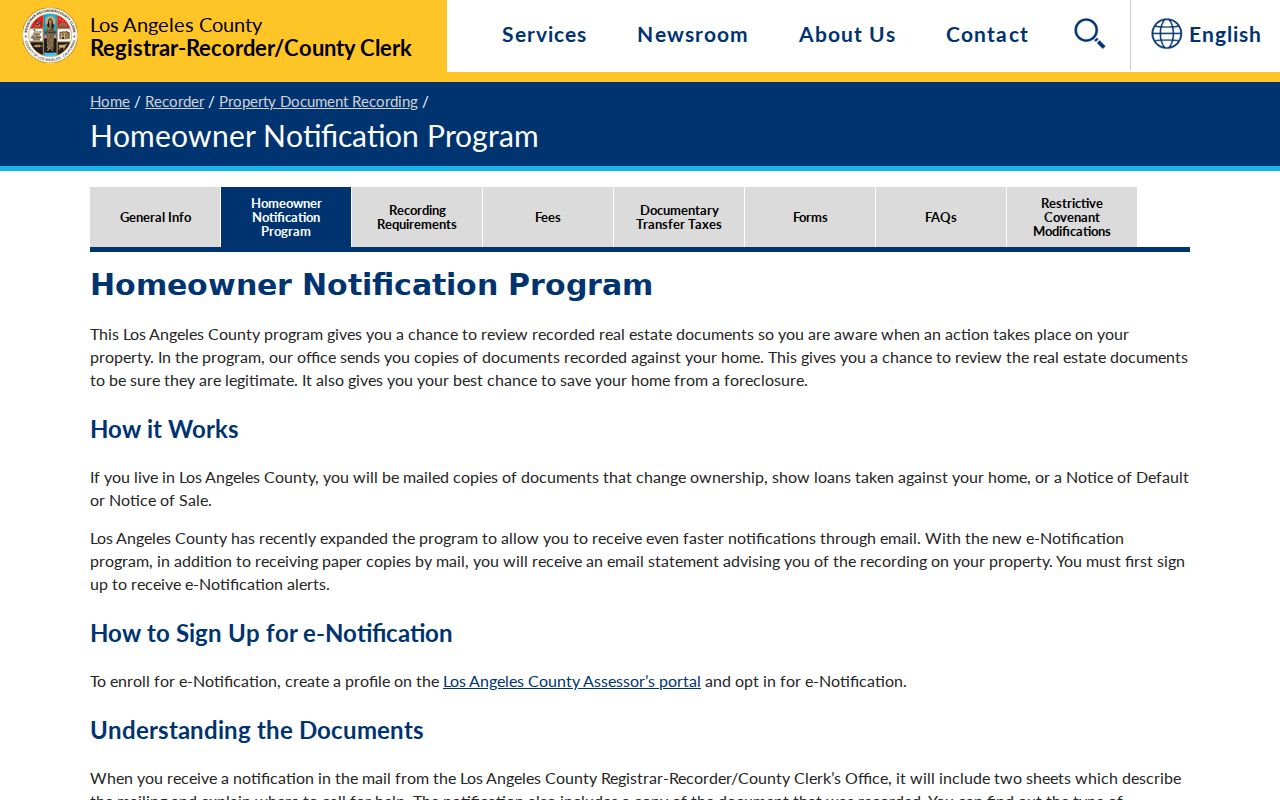
A current parcel owner can add a forward-looking check to a backward house history. The county's Homeowner Notification Program combines mailed notices with an Assessor-profile e-notification option for ownership-changing instruments, loans, notices of default, and trustee-sale notices. It is an alert service, not a title guarantee.
When an alert arrives, compare the document number, APN, recording date, and legal description with the parcel record. Use a phone number or web address published by the county rather than a solicitation. This keeps the previous-residents trail useful for property awareness while leaving the custodian in control of the official record.